
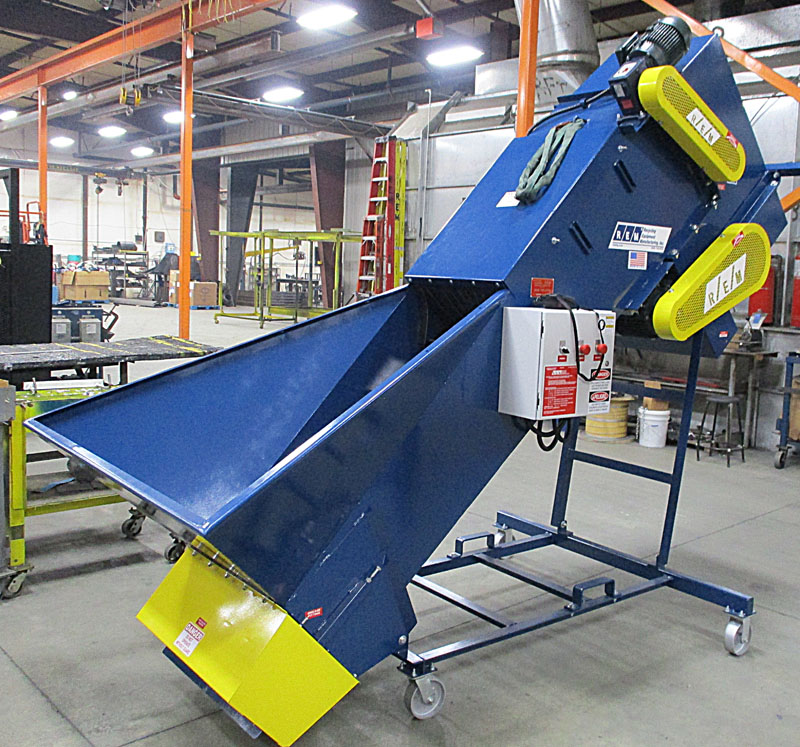
This 3 horsepower REM GB Series Glass Breaker is off to help another County reduce their solid waste costs.
With haul and tip fees generally being charged by the ton it can really pay to remove as much recyclable commodity weight out of the waste stream as possible.
This makes glass a perfect target to divert away from landfill. Glass containers are heavy and can also be punishing on equipment and systems. Most Material Recovery Facilities (MRFs) try to divert the glass out of the processing line as soon as possible to reduce wear and tear on the equipment.
The REM GB 3HP Glass Breaker can process up to 16,000 lbs (8 tons) of glass per hour. Using drop bins for glass and having one for each color saves having to sort glass out of single stream recycling, or worse, out of the waste stream.
As an example, a nearby county pays $84/ton for haulage and tip fees. The average person throws away nearly seventy pounds of glass per year. Even in a small county of 45,000 people that is over 3 million pounds a year. Without a diversion out of the waste stream the raw cost on the local tax base is $132,300 per year. You can start to see why glass diversion may be something a county or municipality would consider. One REM GB 3HP Glass Breaker can handle three million pounds a year with operating just over three and half hours a week.
Need more reasons to start glass recycling? Here are some glass recycling stats courtesy of the Glass Recycling Institute:
Glass Recycling Statistics
- Glass bottles and jars are 100% recyclable and can be recycled endlessly without any loss in purity or quality.
- The container and fiberglass industries collectively purchase 3.35 million tons of recycled glass annually, which is re-melted and repurposed for use in the production of new containers and fiberglass products. (Sources: Precision Consulting, NAIMA)
- Over a ton of natural resources are saved for every ton of glass recycled.
- Energy costs drop about 2-3% for every 10% cullet used in the manufacturing process.
- One ton of carbon dioxide is reduced for every six tons of recycled container glass used in the manufacturing process.
- There are 44 glass manufacturing plants operating in 21 states. There are 63 glass beneficiating facilities (aka “glass processing” plants) in 30 states. At the glass processing plants, recycled glass is further cleaned and sorted to spec, then resold to the glass container manufacturing companies for re-melting into new food and beverage containers.
- In 2017, 39.1% of beer and soft drink bottles were recovered for recycling, according to the U.S. EPA. 39.1% of wine and liquor bottles and 15.1% of food and other glass jars were recycled. In total, 33.9% of all glass containers were recycled.
- States with container deposit legislation have an average glass container recycling rate of just over 63%, while non-deposit states only reach about 24%, according to the Container Recycling Institute.
- Beverage container deposit systems provide 11 to 38 times more direct jobs than curbside recycling systems for beverage containers. (Source: The Container Recycling Institute, “Returning to Work: Understanding the Jobs Impacts from Different Methods of Recycling Beverage Containers”).
- About 18% of beverages are consumed on premise, like a bar, restaurant, or hotel. And glass makes up to about 80% of that container mix.
- In 2008, NC passed a law requiring all Alcohol Beverage Permit holders to recycle their beverage containers. Since then, they have boosted the amount of glass bottles recovered for recycling from about 45,000 tons/year before the ABC law to more than 86,000 tons in 2011.
- Glass bottles have been reduced in weight approximately 40% over the past 30 years.
- Recycled glass is substituted for up to 95% of raw materials.
- Manufacturers benefit from recycling in several ways—it reduces emissions and consumption of raw materials, extends the life of plant equipment, such as furnaces, and saves energy.
- An estimated 80% of all glass containers recovered for recycling are re-melted in furnaces, and used in the manufacture of new glass containers. Source, Strategic Materials, Inc.
- Recycling 1,000 tons of glass creates slightly over 8 jobs. (Source: Container Recycling Institute).
For more information on REM’s GB Series Glass Breakers check out the following link https://remfg.com/products-glass-breakers/.
You can also email [email protected] or call us at 1-800-745-4736 or 208-448-4736